Introduction
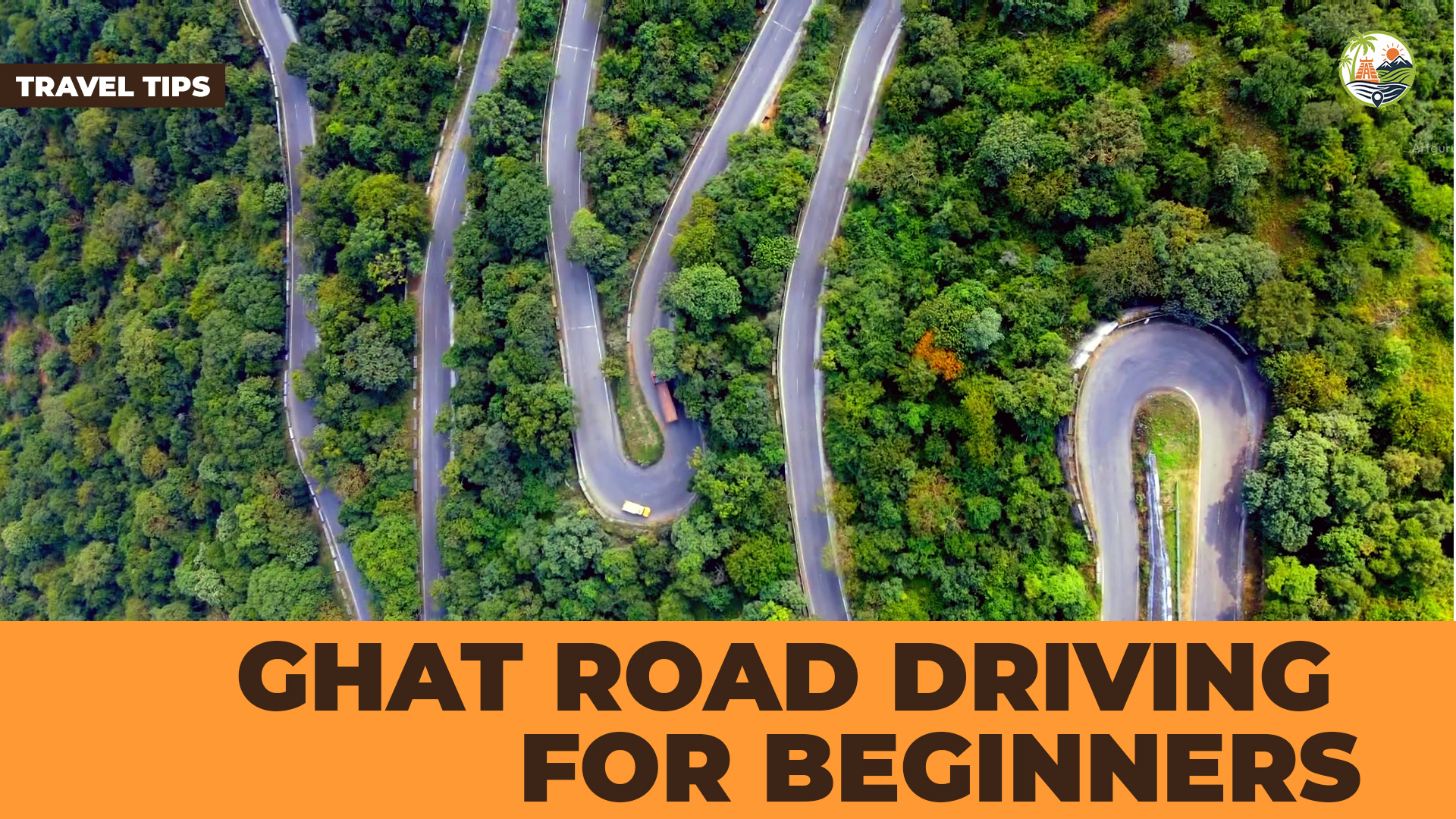
South Indian ghat roads are beautiful, tea estates, mist, waterfalls, and worse than that, a challenge to new drivers. Poor habits can be severely rewarded by changes in elevation, sharp turns and unpredictable weather.
This easy-to-understand tutorial will discuss how specifically to pack, the type of gears to pack, the technique of taking hairpins, and the one thing not to do so that the first ghad trip is easy and non-stressful.
Why South Indian ghats feel different
- Topography changes rapidly: open valleys, narrow estate lanes and thick woodland in an hour.
- Monsoons and mossy patches that are heavy diminish grip; the fog appears out of thin air.
- Common destinations (Ooty, Munnar, Wayanad, Kodaikanal, Yercaud, Valparai, Agumbe, Kolli Hills) also contain sharp slopes and deep descents that cause the brakes to perspire when you work by the peddle alone.
- The excavations are through the wildlife areas where the speed rate and nighttime closures have to be observed–overtaking and honking can also be limited.
Pre‑drive checklist (car, bike and EV)
- Pre-drive checklist (car, bike and EV) Tyres: inflated to or a little less than recommended cold pressure when you have full load and have to travel long downhill grades; never overinflated. Tread depth matters in rain.
- Brakes: normal, no pulling, no squeal; check fluid. Not sure, service before the trip.
- Lights & wipers: low beam centering, operational fog lights, good wipers, clean window.
- Cooling, power Need to add coolant; with EVs, begin with a healthy charge–regen works best with a headroom (not full).
- Mirrors & horn: this should be placed in front of rolling; horn is necessary on blind bends.
- Load: tie up luggage; heavy stuff down and in the middle.
- Rest: when fatigued, do not begin to descend, hydrate and rest.
Dos & Don’ts (quick table)
| Situation | Do | Don’t |
|---|---|---|
| Long descent | Use engine braking in a lower gear; short, firm brake taps | Ride the brakes continuously; coast in neutral or with clutch pressed |
| Hairpin bend | Downshift before the turn, honk once, keep to your lane | Cut corners or swing wide into oncoming lane |
| Fog/rain | Low beam or fog lamps, double the gap, smooth inputs | High beam in fog, sudden braking, hazard lights while moving |
| Uphill start | Use handbrake or hill‑hold; release clutch/brake smoothly | Roll back; slip the clutch for long seconds |
| Overtaking | Only on visible straights with clear space ahead | Attempt on blind corners or crests |
| Stops & photos | Park fully off the carriageway at designated viewpoints | Stop on the apex/exit of a bend |
| Wildlife zones | Slow, silent, lights on low beam; let animals pass | Honk constantly; step out of the vehicle |
| Night driving | Reduce speed, clean windshield, watch for unlit vehicles | Drive tired or chase local drivers’ pace |
Speed, gear and braking guide
| Vehicle/Transmission | Climb (typical) | Descent (typical) |
|---|---|---|
| Manual petrol/diesel | Use 2nd–3rd gear on moderate grades; 1st for steep hairpins | Descend in the same gear you’d use to climb; 2nd or even 1st on very steep sections |
| Automatic (AT/CVT/DCT) | Use manual mode or “L/2/B” on climbs | Select “L/2/B” or manual downshift to hold lower gears for engine braking |
| EVs | Normal drive with adequate regen; pre‑set highest regen level | Highest regen + gentle brake taps when needed |
Tip: If the brake pedal gets soft or smells, pull over safely, keep the car in gear, use the handbrake, and let brakes cool for 10–15 minutes.
Hairpin technique and cornering lines
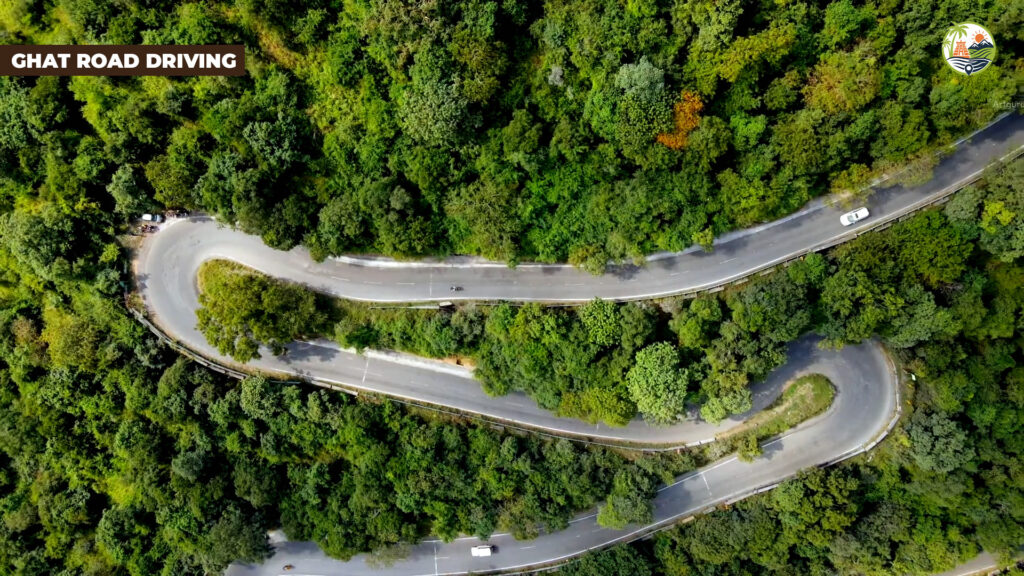
- Approach: Slow early, downshift before the curve, look as far through the corner as possible.
- Position: Stay left and wide on entry, tighten at the apex, return to left on exit–always within your lane.
- Throttle: Gentle, linear throttle after the apex; avoid sudden acceleration on wet surfaces.
- Communication: A short horn toot before blind hairpins; indicators for pull-outs; thank drivers who give way.
- Right-of-way: Uphill traffic gets priority. If you’re descending and space is tight, stop early at a wider patch and let them pass.
Monsoon, fog and night driving
- Monsoon: Expect moss, leaves and diesel patches–especially near bus stops and hairpins. Brake earlier and straighter; avoid puddles that may hide potholes.
- Fog: Use low beam or dedicated fog lights; high beam reflects back. Follow the painted center/edge lines, not tail-lights only. If visibility is very poor, pull into a safe bay and wait.
- Night: Cut speeds by 20-30%, watch for unmarked speed breakers, parked trucks and animals. Keep the windshield inside and out free from haze to prevent glare.
Two-wheeler specifics
- Gear and posture: Keep a light grip, elbows relaxed, eyes up. Enter slow, exit smooth; avoid mid-corner braking.
- Braking: Use both brakes; on wet hairpins bias slightly to the rear to avoid front lock (if no ABS).
- Downhill control: Engine braking in 2nd gear works well; don’t coast in neutral.
- Clothing: Full-face helmet, gloves, ankle-covering shoes or boots, rain layer in monsoon.
- Luggage: Balance saddle bags; avoid tall top loads that upset handling.
Overtaking, etiquette and wildlife corridors
- Etiquette: If you have a faster vehicle behind, use a safe straight to indicate left and let them pass. Do not tailgate–leave room for unexpected stops.
- Buses and trucks: They need space across hairpins; anticipate their wider turning circle and wait rather than squeeze through.
- Wildlife corridors (Bandipur-Wayanad, Anaimalai-Valparai, Periyar fringes): Adhere to posted speed limits, avoid honking, and note that some roads close at night. Never stop near animals for photos.
Emergency prep and what to do if brakes fade
- Essentials to carry: triangle reflectors, flashlight, rain ponchos, power bank, basic first-aid, tyre inflator/sealant, and a tow-rope for cars.
- If brakes fade: Downshift immediately, use engine braking, pull into a lay-by, keep wheels straight, apply handbrake in steps; let components cool.
- If engine overheats: Heater on full-hot (it helps dissipate heat), pull over, idle with bonnet open; don’t open the radiator cap when hot.
- Contacts: Save 112 (emergency), manufacturer roadside assistance, and local highway patrol numbers; share live location when you have signal.
Conclusion
Ghat driving is a skill you’ll enjoy for life. Prepare your vehicle, pick the right gear before each bend, respect weather and wildlife, and stick to the dos & don’ts above. With smooth inputs and patience, South India’s hairpins become less scary and more scenic–exactly the kind of drive you’ll want to repeat.
